












Digital transformation isn’t just about adopting new technology—it’s about changing the way your firm works.
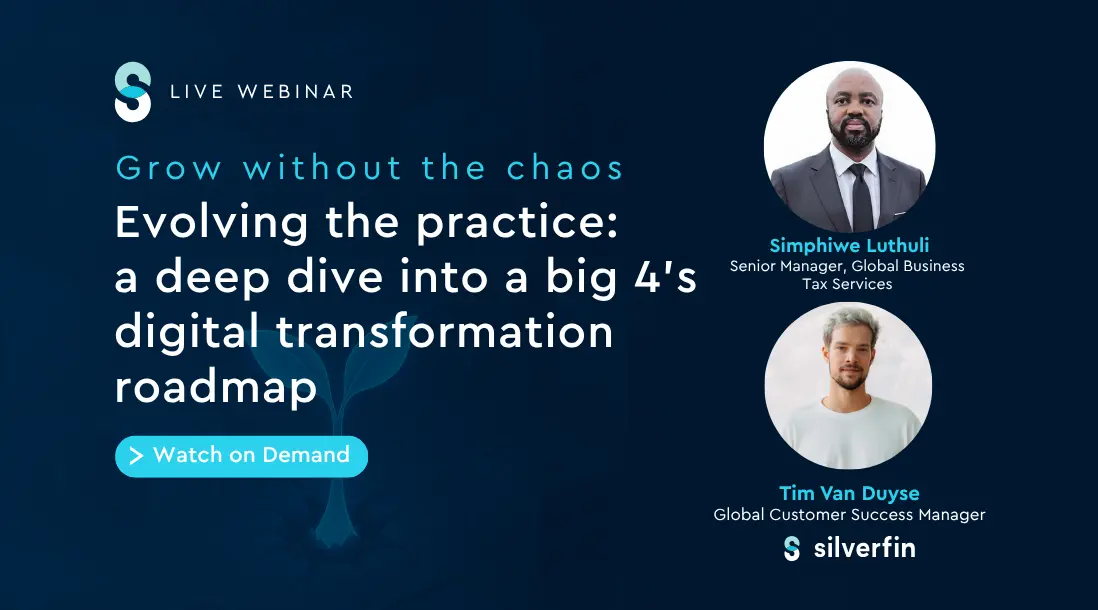
That was the central theme of our recent webinar, Evolving the practice: A deep dive into a Big 4’s digital transformation roadmap. Hosted by Tim Van Duyse, Global Customer Success Manager at Silverfin, the session featured Simphiwe Luthuli, Senior Manager, Global Business Tax Services in South Africa, who shared first-hand insights into how a Big Four firm transformed its tax compliance process by moving away from Excel and towards a scalable, cloud-based way of working.
For firms facing growing compliance demands, increasing pressure on margins and rising client expectations, the conversation offered practical lessons on what it really takes to modernise a tax practice. If you couldn’t join us live, here are the key takeaways.
Why change became a business necessity
For many accounting and tax firms, Excel has long been the backbone of tax compliance. While familiar and flexible, it also comes with limitations that become more apparent as firms grow.
This was exactly the challenge the firm faced. Its Excel-based tax pack had become increasingly difficult to manage. Large file sizes, version control issues and data integrity challenges made collaboration cumbersome, while manual processes consumed valuable time across every engagement.
At the same time, another challenge was becoming impossible to ignore: compliance fees were under pressure. Clients expected firms to deliver more value and greater efficiency, but they weren’t willing to pay significantly more for compliance work year after year.
Rather than accepting shrinking margins, the team recognised that continuing with manual processes wasn’t sustainable. They needed a smarter way of working—one that would automate repetitive tasks, improve consistency and free up time for higher-value work.
Choosing technology that could grow with the firm
Finding the right technology wasn’t simply about replacing Excel.
Several local solutions were evaluated, but many lacked the flexibility needed to build a robust, customised tax compliance workflow. The breakthrough came after connecting with colleagues elsewhere in the global network who were already using Silverfin. Seeing the platform in practice demonstrated that it could do much more than digitise spreadsheets—it offered the flexibility to build a solution tailored to the firm’s own methodology while creating a foundation that could continue evolving over time.
The objective wasn’t simply to recreate existing processes in a new tool. It was to build a future-ready platform capable of supporting the firm’s long-term ambitions.
Building a solution with every user in mind
Developing the platform required close collaboration between technical specialists and tax professionals.
Rather than starting from scratch, the team used its existing Excel tax pack as a foundation, rebuilding schedules, calculations and workflows while rigorously testing every component throughout the development process.
Importantly, the focus wasn’t only on making life easier for preparers.
The ambition was to improve the entire compliance workflow—from junior staff preparing returns through to managers, directors and partners reviewing them. By designing the solution around every stage of the process, efficiencies could be created across the whole engagement rather than for just one group of users.
The biggest challenge wasn’t the technology—it was change management
One of the strongest messages throughout the webinar was that successful digital transformation depends just as much on people as it does on technology.
For professionals who had spent decades working in Excel, adopting a completely new platform naturally required a change in mindset. Interestingly, the biggest challenge wasn’t learning how to use the software—it was learning to trust it.
Many reviewers continued manually checking calculations that had already been verified automatically because they didn’t yet fully understand or trust the platform’s automation.
Looking back, one lesson stood out clearly: invest in change management before implementation begins.
Creating awareness early, explaining why the transformation is happening and helping teams understand how automation supports their work builds confidence long before the first client engagement.
Timing also proved critical. Launching a new platform immediately before busy season left little room for people to learn while managing tight deadlines. Allowing teams two to three months before peak periods gives them the opportunity to complete several real engagements, build confidence and provide valuable feedback before workloads increase.
Effective training is tailored to every role
Another valuable lesson was that effective training isn’t one-size-fits-all.
Initially, everyone attended the same training sessions, regardless of their role. However, it quickly became clear that preparers, managers and partners all interact with the platform differently and therefore require different learning experiences.
The approach evolved into role-specific training sessions focused on the day-to-day responsibilities of each audience. Preparers learned how to complete returns efficiently, reviewers focused on understanding the automated checks, while senior leadership explored how the platform supported oversight and quality.
Making training more relevant to each role significantly improved adoption and helped users gain confidence more quickly.
Digital transformation is an ongoing journey
The benefits of the project extended well beyond improving operational efficiency.
Having already standardised many of its tax compliance processes, the firm was well positioned when broader transformation initiatives were introduced across its global network. Instead of starting from scratch, much of the groundwork had already been completed.
The success of the project has also created opportunities to scale. The solution is now being rolled out across additional African member firms, while the firm’s internal tax team has adopted the same platform without requiring additional development.
Looking ahead, the ambition is even broader. The long-term vision is to make the solution available directly to clients, enabling a more connected and collaborative tax compliance process while continuing to refine the experience through internal rollouts first.
Key takeaways for firms considering digital transformation
Every firm’s journey will be unique, but several themes emerged consistently throughout the discussion:
- Start by solving business challenges—not simply replacing technology.
- Choose a platform that is flexible enough to grow with your firm.
- Design workflows that create value for every user, from preparers through to partners.
- Treat change management as a core part of the implementation—not an afterthought.
- Deliver role-specific training to improve adoption.
- Give teams sufficient time to gain confidence before busy season begins.
Ultimately, digital transformation isn’t about replacing Excel with another tool. It’s about creating a more efficient, scalable and resilient way of working that enables firms to deliver better outcomes for both their people and their clients.
Watch the webinar on demand
Want to hear the full conversation and discover more practical insights from this Big Four transformation journey?
Watch the webinar recording to hear the complete discussion and learn how firms can successfully modernise their tax compliance processes.
Ready to modernise your tax compliance process?
Whether you’re looking to reduce manual work, standardise tax workflows or create more capacity for higher-value advisory services, Silverfin can help.
Book a personalised demo to discover how Silverfin helps leading accounting and tax firms transform compliance with a cloud-based platform built for the future.
FAQs
As firms grow, Excel-based tax processes often become difficult to manage due to version control issues, large file sizes, manual data entry and collaboration challenges. Moving to a cloud-based tax compliance platform helps automate repetitive tasks, improve data accuracy and create more efficient, scalable workflows.
Technology is only part of the transformation. One of the biggest challenges is change management. Teams need time to understand, trust and adopt new ways of working. Communicating the reasons for change, providing role-specific training and allowing time to build confidence before busy season are critical to successful adoption.
Successful implementations start by solving business challenges rather than simply replacing existing tools. Firms should choose a flexible platform, involve users from across the business, invest in change management, tailor training to different roles and allow sufficient time for teams to adapt before peak workloads.
Cloud-based tax compliance software helps firms standardise workflows, reduce manual work, improve collaboration, automate calculations and strengthen data integrity. It also provides a scalable foundation that can support future growth, new services and ongoing digital transformation initiatives.
Firms should begin by identifying the business problems they want to solve, such as inefficient workflows or shrinking compliance margins. From there, they should select technology that supports long-term growth, engage stakeholders early, prioritise change management and provide role-specific training to encourage adoption across the firm.