











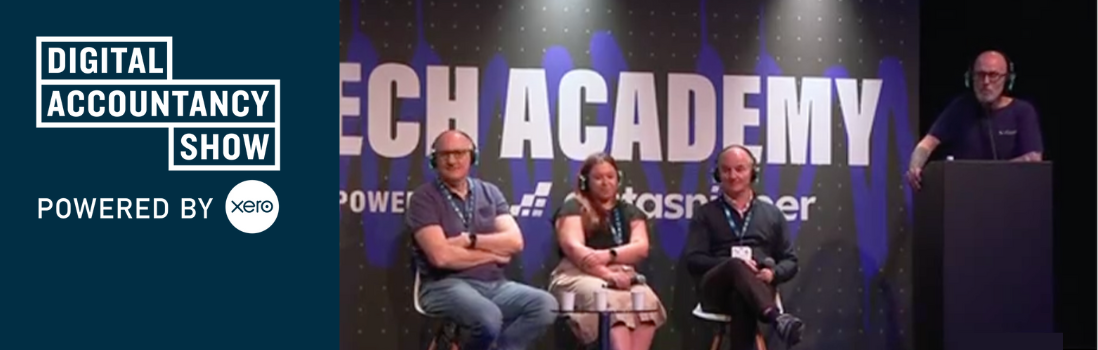
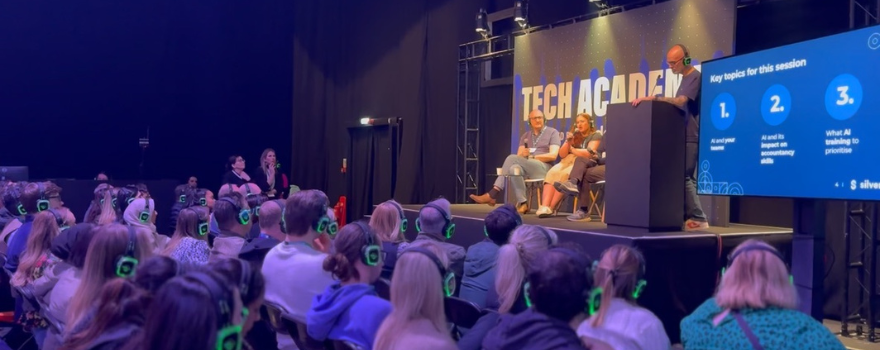
At this year’s Digital Accountancy Show, Silverfin had the privilege of hosting a panel that tackled one of the most important—and often overlooked—aspects of AI adoption in the profession: its impact on your people.
Titled “Making AI Humanly Possible,” the session explored how AI is reshaping the accounting industry—not just through automation, but in how firms train, structure and support their teams.
Led by Phil Hobden, Silverfin’s UK Sales Lead, the panel featured Angus Macgregor (Chief People Officer, Shaw Gibbs), Hollie Moore (Head of Early Careers, BKL), and Richard Spofforth (Head of Accounts & Outsourcing, Kreston Reeves). Together, they unpacked how firms can embrace AI without losing sight of their most important asset: their people.
Here are some of the key takeaways:
Rethinking AI: It’s not about the tools
Phil opened with a simple but powerful statement: “Artificial intelligence is not a substitute for human intelligence—it’s a tool to amplify it.”
While most AI discussions focus on software, automation and operational efficiency, this session shifted the focus. It asked: What does AI mean for teams? How do we avoid de-skilling talent? And are we building the right skills for a future where AI is embedded in everyday workflows?
Collaboration, not just calculation
Richard Spofforth shared how Kreston Reeves is using Microsoft Teams Premium and AI transcription tools to improve audit planning meetings. These tools don’t just save time—they enhance the quality and completeness of outputs, reduce errors, and free teams to focus on more valuable work.
“We used to spend over an hour writing up notes after a planning meeting. Now, with transcripts and summaries automatically generated, nothing is missed—and we’re able to have more focused, more productive sessions,” he said.
Hollie Moore added a people development perspective. At BKL, AI has helped our audit teams shift from repetitive tasks like invoice sampling to more meaningful analysis and collaboration. “It means our juniors are getting involved in ‘meatier’ parts of the job sooner,” she explained, “which accelerates their growth and keeps them engaged.”
The risk of de-skilling: A warning worth heeding
Despite the clear benefits, the panel didn’t shy away from AI’s potential downsides.
Hollie noted a growing concern: “Are we creating a generation of accountants who don’t really understand what’s happening in the background? If we skip foundational skills like double-entry bookkeeping, what happens when the tech goes wrong?”
Richard echoed this, raising a broader point around wellbeing. “If all that’s left is the complex, high-stakes work, that has a mental health impact. We all need a balance—some of the easier tasks serve a purpose, even if they’re automated.”
Angus Macgregor, drawing on his experience in legal and hospitality sectors, spoke about the training and support gap that often emerges when lower-level tasks are removed. “In call centres, AI stripped out routine enquiries, leaving staff with only the hard cases. It raised expectations but didn’t always come with the right support. That’s a real risk here too.”
A call for a new training model
The consensus? We need to rethink how we train people. Traditional models won’t cut it in an AI-first world.
“Training in accountancy hasn’t really evolved for years,” Hollie said. “Right now, we teach people how to use the software—but not what it’s actually doing. That has to change.”
Richard made an interesting comparison: “Firms like Bain and McKinsey can take graduates and turn them into high-performing financial analysts without traditional accounting training. Why can’t we do the same?”
Strategy, structure and the role of leadership
Angus Macgregor brought the conversation back to the organisational level. “We need a proper strategic plan—not just around which tech we’ll adopt, but how we roll it out across different career stages, and how we support everyone through that change.”
Leadership, he argued, needs to play an active role. “This isn’t optional. This is about long-term viability. The top of the house needs to buy into it—and cascade that commitment down.”
Richard offered a practical perspective. “We’ve started rolling out Copilot Chat across the business—not just to senior managers, but everyone. The idea is to test, learn, and see who’s actually using it. That helps us identify internal champions and drive adoption in a more organic way.”
A generational opportunity — If we let it happen
The discussion closed on a positive note. There is a real opportunity to empower younger professionals—many of whom are already fluent in AI tools—to contribute in a meaningful way.
But that only happens if firms are willing to listen. “We need to create space for new ideas,” Hollie said. “People moving between firms often bring brilliant approaches with them. Are we set up to hear them?”
Phil wrapped things up by framing it as a mindset shift. “We’re not just automating tasks—we’re redefining what it means to be an accountant. AI is here, yes—but how we implement it, who we empower, and how we bring people on the journey? That’s where the real change lies.”
Final thoughts
This session was a reminder that technology is only half the story. AI might be reshaping workflows—but the firms that thrive will be those that invest just as heavily in people, culture and change management.
For us at Silverfin, that’s what “making AI humanly possible” really means.