












Most AI announcements in fintech read like they were written by someone who’s never had to finish a working paper under deadline. A slick 30-second video, a few buzzwords – and all the messy discovery work quietly tucked out of sight.
So here’s the honest version: what we’re actually piloting, how we’re testing it, and what we still don’t know.
The goal is narrow and practical. We’re automating the routine grind of compliance, working papers, accounts prep and standard trial balance checks, so the work gets done on time and the accountant stays fully in control. We’re aiming for a significant time saving across working papers and file prep, cutting out data tedium that eats up the day. We’re not replacing anyone. We’re freeing accountants to spend less time checking figures and more time helping clients understand them.
Our version one
Our first approach is an open-ended chat interface that lives inside your client file. It can help you look through the data quickly and complete tasks such as summarising ledger data or importing data from documents by creating proposals for you to review. It’s deliberately open-ended to see what helps users the most, and from our workshops, users have lots of good ideas.
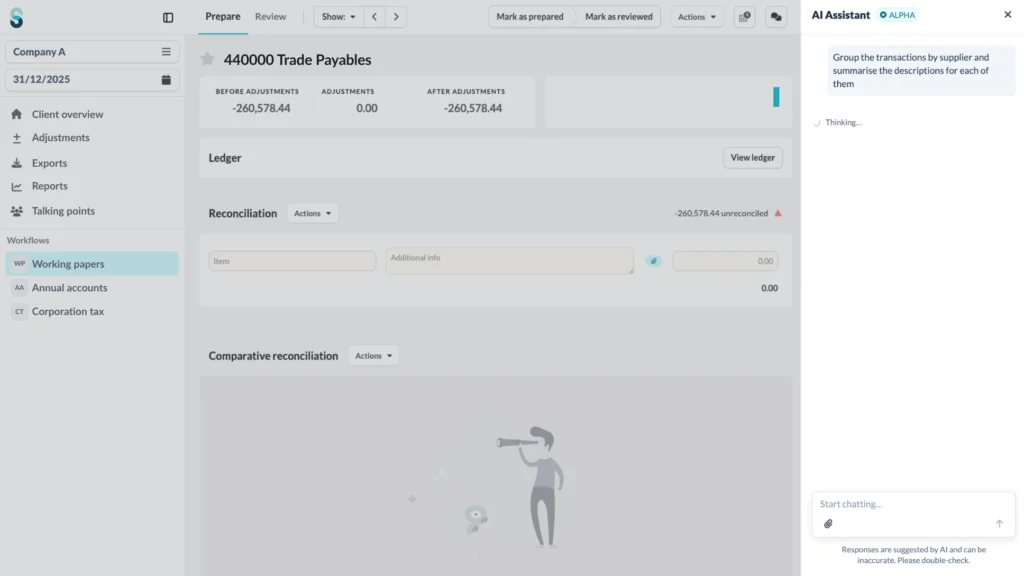
V1 chat interface (English)
Why we started with an agentic chat interface
This technology is early, and nobody has settled yet on the right way for accountants to work with AI. So we’re building to learn. Our early prototypes sit behind an agentic chat interface, for two reasons. It lets people ask for things in their own words, which surfaces the questions they naturally reach for and where the friction really is. And it gives our team room to test different workflows behind the scenes without boxing people into a fixed set of buttons.
Chat is how we’re learning, though, not necessarily where this ends up. Accountants don’t work in a single thread all day. You’ve got several things running while you move between files, so later versions may look more like a task manager, with agents working in the background and flagging you only when they need a decision.
What we’re trying to find out
Building something quickly is easy. Building something accountants trust enough to use is the hard part. Three questions are driving the pilots:
- Do we have the structured data underneath for an agent to handle multi-step compliance tasks cleanly, using live ledger and context data without inventing figures it can’t find.
- Will a preparer trust the output enough to approve it quickly. That comes down to how clearly we show the agent’s reasoning, because nobody signs off on work they can’t follow when their name is on it.
- Does it actually save time once you add the review. We’re measuring agent prep plus human review against doing the whole thing manually, to be sure we’re removing work rather than just moving it.
The risks we’re keeping an eye on
If anyone claims they’ve solved AI in compliance with no trade-offs, they’re not being straight with you. Two risks in particular have our attention.
- The first is review fatigue. Look at software engineering, where AI coding tools are already everywhere. The common complaint from senior engineers is that their day has shifted from solving problems to checking the AI’s work. We want the accountant’s day to feel lighter, not like managing another junior, so we’re watching closely how our pilot users actually feel.
- The second is accuracy. AI won’t be right every time, so the question is how firms get the benefit while managing that. This isn’t new ground. Firms already run reviews and controls to catch errors, and we want to learn which of those work best alongside an agent.
What’s next and how to get involved
So far we’ve been running this with a very small group of users, and their input is shaping everything we build. For the next stage we want to bring in a few more enthusiasts to help design what compliance tooling should become, working directly with our product and engineering teams.
Join and you’ll get early access to the prototypes, a direct line to the people building them, and a real say in how AI fits into Silverfin’s templates.
We’ll take a limited group based on role and AI experience. Help us fix the daily compliance grind so your team can get home on time.